
Unlocking the trustee dividend
Charity trustees bring unique skills, networks, perspectives, experience and expertise to charities. In the vast majority of cases, trustees are diligent, capable and committed to the mission.
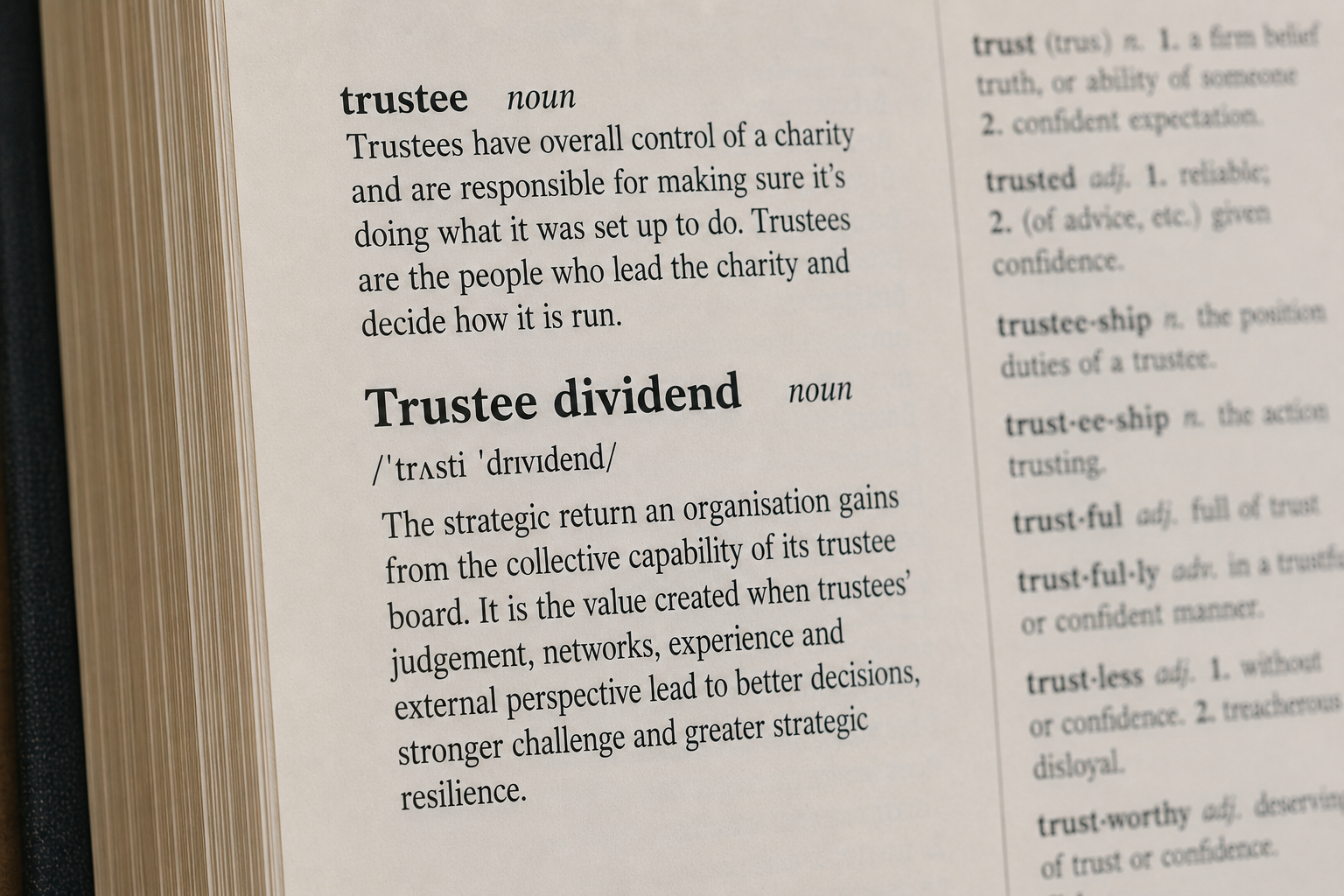
The trustee dividend is the strategic return all of that should generate for the organisation.
In many boards, that dividend is significantly under-realised. This is often because a busy board is not necessarily an effective one.
The boards that unlock the dividend are the ones that use board time to ask questions that challenge assumptions, stretch ambitions, and change choices.
Introduction
If you lead an organisation, especially one with an ambitious social progress mission, ask yourself this question:
When did your board last have a conversation that genuinely changed how you think about the future?
If the answer does not come quickly, you may not be unlocking your trustee dividend.
What is the trustee dividend?
Charities work hard to assemble trustee boards with a balanced set of skills, networks, perspectives, experience and expertise. In the vast majority of boards we work with, trustees are diligent, capable and committed to the mission. They show up, read the papers, scrutinise performance, test risks, oversee finances and take their responsibilities seriously.
The trustee dividend is the strategic return an organisation should get from this collective capability. It is not a financial return. It is the value created when trustees’ unique mix of skills, expertise, and experience help to shape better choices about the organisation’s future.
At its best, the dividend shows up in sharper questions, stronger challenge, better decisions, wider perspective and greater strategic resilience.
Failing to realise the dividend
The problem is rarely the capability or commitment of trustees themselves. More often, governance practices simply do not create the structure or space for trustees to contribute at their full strategic potential.
Scrutiny, support and stewardship become the default mode of board engagement. These are essential disciplines and this is not an argument for lighter scrutiny. Weak assurance does not create strategic boards, it creates risk. But so does a lack of regular board conversations on strategy and stretch.
We see the problem show up in familiar ways. The future only gets discussed properly once every three or five years, usually during a strategy cycle. Board agendas focus in and down, with little time to look up and out. Leadership teams feel held to account, but not always helped to think beyond day-to-day delivery pressures. Trustees and executives feel disconnected and distant from the big trends shaping their field.
This creates a misalignment between what the board actually spends its time on and what the board could be spending its time on to help stretch the organisation.
Unlocking the dividend
When organisations sense they could be getting more from their trustees, the first instinct is often to reach for more information: more reports, more dashboards, more data, more detail.
Better information and data can help, but the trustee dividend cannot be unlocked by this alone. It is unlocked by bigger questions, better-designed conversations, and clearer links between board discussion and strategic choice.
Three practices can begin to help you to unlock your trustee dividend:
1. Protect time for strategic conversation
Strategic time has a habit of disappearing. A board that resolves to “do strategy in the second half of the meeting” will often find that the second half never quite arrives.
Boards that get this right treat strategic time as non-negotiable. They put a single strategic question first on the agenda, not last. They use committees, tighter papers or consent agendas to handle operational scrutiny. They explicitly design in regular strategy conversations and deep dives into their board meetings and annual cycles.
The mechanics matter less than the principle: strategic conversation has to be deliberately designed and actively protected, or it disappears.
2. Use uncertainty as material for strategy
Boards often avoid conversations about the future because the future is uncertain. That is precisely why they should have them.
What happens if unrestricted income declines faster than expected? What if demand doubles but funding stays flat? How might AI change the way beneficiaries find support? What if public trust in institutions continues to decline?
These questions do not require anyone to predict the future accurately. They require honesty about the assumptions built into the current strategy. The point is not to be right about what comes next. It is to prepare the organisation for a range of possible futures and build a more resilient and adaptive strategy.
3. Ask questions that change the frame
Many board questions that appear strategic are actually management questions in disguise. Are we on track? Are KPIs moving in the right direction? Is the budget on course? These are useful and important questions, but ones that often pull the conversation towards operations.
Strategy and stretch questions look, sound and feel different. What are we working on that we should stop doing? Where are we playing it safe because it is comfortable rather than right? Which assumptions in our strategy would be most dangerous if they proved false? What would we do differently if we started from the people least well served by our current model?
These questions move the conversation from inside-out: our resources, risks, plans and constraints; to outside-in: beneficiaries, funders, partners, peers, future entrants and the wider system.
Realising your dividend
The trustee dividend often stays locked away because a busy board can look like an effective one. Full agendas feel productive, detailed board packs feel rigorous and thorough scrutiny feels responsible.
The boards that unlock the dividend are the ones that use board time to ask questions that challenge assumptions, stretch ambitions, and change choices.
The trustee dividend is already in the room. The question is whether your governance practices are designed to unlock it.