
Residues of ritual: what will we look back upon in 2046?
We were fortunate to be invited by Gem Barton to an exhibition of her students' work exploring ‘residues of ritual’. Artefacts from the past 20 years, looking back from 2046 that bring future worlds to life at the intersection of foresight, spatial design and design fiction.
Futures thinking isn't about predicting what will happen. It's about being better prepared by creating space to explore hard questions, engage constructively with uncertainty, and be resilient to a range of futures.
Over 10 weeks, students entirely new to futures thinking, from across the School of Architecture at the Royal College of Arts, built speculative artworks, prototypes, films, costumes and sets to imagine future lives through what is retained.
Some particularly provocative ‘what if’ questions raised by the pieces included:
What if water shortages transformed housing culture from an individualistic model into a collectively organised way of living
What if our relationship to food morphs to match our relationship to digital content, moving away from fixed meals, towards a distribution across continuous, fragmented moments throughout the day?
What if resource scarcity means that construction is no longer seen as a one-time process but instead households see construction as an ongoing ritual of recycling, reuse and renewal?
What if sleep, focus and productivity are no longer seen as private virtues, but instead treated as public goods legitimately controlled, optimised and harnessed by governments and employers?
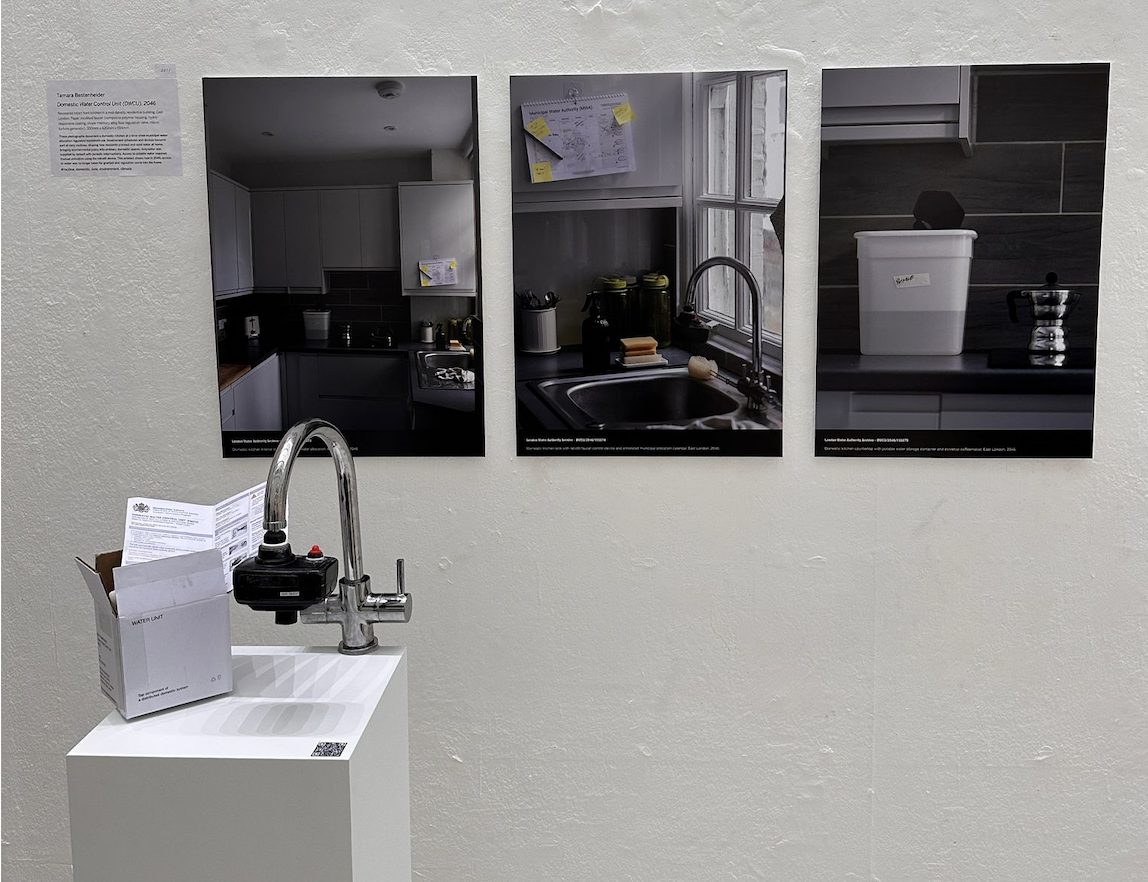
Tamara Bestenheider - Domestic Water Control Unit (DWCU), 2046
Across the works, several themes kept recurring: water scarcity and environmental pressures; the increasing monitoring and medicalisation of our bodies; and growing government and corporate control of individual lives in response to economic and environmental transformation.
Whilst these are themes that commonly emerge in foresight work, the novel contribution of the course and exhibition was the integration of robust futures methods into speculative design fiction. This concretely rooted these future worlds through experiential ‘residues of ritual’ from everyday life, the built environment, and material choices.
The value of futures and foresight is too often diminished by its outputs. Trend decks and long reports struggle to make abstract scenarios feel real or urgent. The deeper value frequently lies in the process itself: the skills developed, the new ways of thinking unlocked, the conversations opened up.
This exhibition is a compelling example of what that space can look like, bringing to life the real choices, material constraints and potential societal responses we may face. Experiential methods like this help us to move beyond ‘futures thinking’ toward futures touching, feeling and seeing.
This gives people new and different ways to engage with those future worlds, opening up more space for interesting questions and provocations to emerge.
Huge thanks to Gem, team and the RCA for putting on the exhibition, extending an invite, and creating engaging futures.